What Are Statutory and Non-Statutory Services? A Complete Guide for Indian Employers
If you’re running a business in India—small or large, based in Chennai, Bengaluru, or anywhere across the country—you’ve probably heard the terms “statutory” and “non-statutory” services thrown around in HR conversations. But what do they actually mean for you as an employer? And why should you care?
Here’s the thing: understanding the difference between these two categories isn’t just about compliance—it’s about protecting your business from legal trouble while building a workplace that people actually want to work in.
In this guide, we’ll break it all down in simple, conversational terms. We’ll look at what the law demands, what makes sense for your business, and how you can navigate both to create an employer brand that stands out—especially in competitive talent markets like Chennai and Bengaluru.
Statutory Services: What the Law Demands
Statutory services are the mandatory obligations that every employer in India must fulfill under various labor laws and regulations. Think of them as the non-negotiable baseline—the rules you simply cannot skip, regardless of how small your team is or how new your startup might be.
These aren’t optional perks or nice-to-haves. They’re legal requirements, and failing to comply can result in penalties, fines, legal action, and serious damage to your company’s reputation.
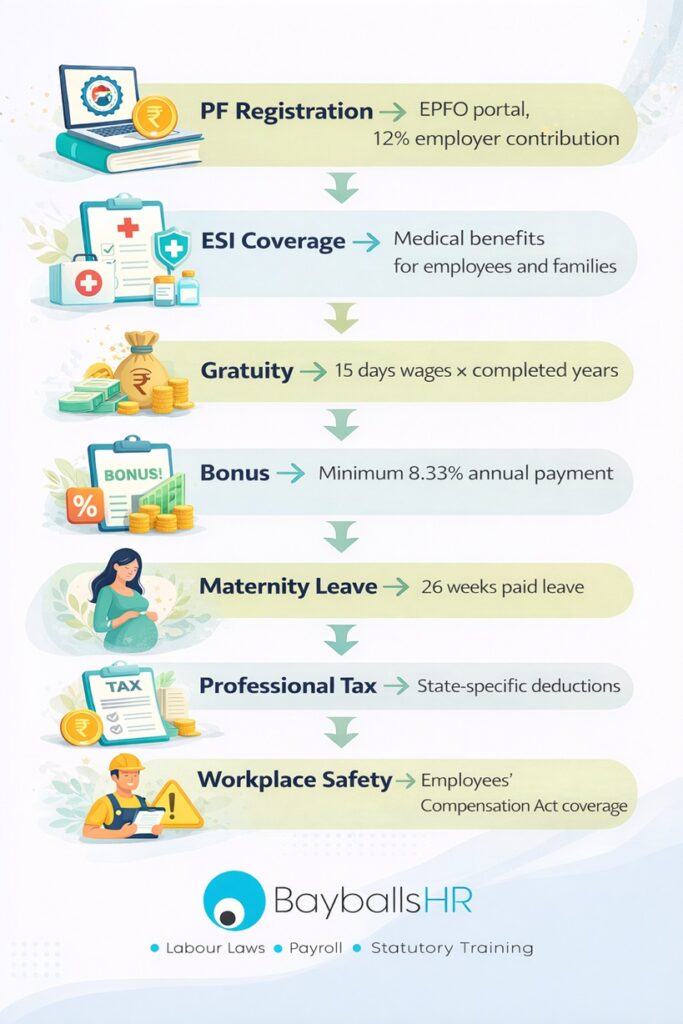
Key Statutory Services in India
Statutory Benefit
Governing Law
Key Requirements
Provident Fund (PF)
Employees’ Provident Funds and Miscellaneous Provisions Act, 1952
Employer contributes 12% of basic wages; must register with EPFO
Employee State Insurance (ESI)
Employees’ State Insurance Act, 1948
Employer contributes 4.75% (for establishments with 10+ employees)
Gratuity
Payment of Gratuity Act, 1972
Pay 15 days’ wages for every completed year of service after 5 years
Bonus
Payment of Bonus Act, 1965
Minimum 8.33% of wages as annual bonus
Maternity Benefits
Maternity Benefit Act, 1961
26 weeks paid leave for women employees
Employee Compensation
Employees’ Compensation Act, 1923
Compensation for work-related injury/death
Professional Tax
State-specific
Tax deduction from employee salaries (varies by state)
Why Statutory Compliance Matters
Here’s the reality: India has some of the most comprehensive labor protections in the world. We have over 50 central labor laws and numerous state-level regulations covering everything from wages to workplace safety.
For employers in Chennai and Bengaluru—two of India’s major business hubs—keeping up with these requirements is especially critical. These cities have active labor enforcement, and companies with strong compliance reputations attract better talent and investor confidence.
The key takeaway: Statutory compliance isn’t optional. It’s the foundation upon which you build your employer’s reputation. Get this right, and you’ve earned the right to focus on growth. Get it wrong, and it can haunt you for years.
Non-statutory services are the voluntary HR initiatives that organizations offer to attract, retain, and develop their talent. These are the things that aren’t mandated by law—but smart employers offer them anyway because they deliver measurable business value.
Think of non-statutory services as your competitive advantage in the talent marketplace.
Common Non-Statutory Services in Indian Workplaces
Category
Examples
Business Impact
Health & Wellness
Medical insurance, dental coverage, mental health programs, gym memberships
Reduced absenteeism, higher retention
Financial Security
Life insurance, disability cover, voluntary provident fund, stock options
Training programs, certifications, tuition reimbursement, conference attendance
Skilled workforce, internal talent pipeline
Perks & Rewards
Meal vouchers, transport allowances, phone bills, work-from-home setup
Attract top talent, boost morale
Recognition Programs
Employee of the month, spot bonuses, peer recognition
Higher engagement, positive culture
The Chennai and Bengaluru Factor
In cities like Chennai and Bengaluru—where the talent competition is fierce—non-statutory benefits can be the difference between landing a great candidate or losing them to a competitor.
Bengaluru’s tech workforce, in particular, expects comprehensive benefits packages. Chennai’s manufacturing and IT sectors are similarly competitive. Companies that offer robust non-statutory packages consistently rank higher in “best places to work” surveys and employee satisfaction metrics.
Here’s my honest take: you cannot afford to focus on only one category.
The employers who build truly sustainable organizations understand this balance:
Statutory compliance protects you legally—it’s the cost of doing business in India
Non-statutory benefits attract and retain talent—they’re the investment in your company’s future
In Chennai and Bengaluru especially, I’ve seen companies that technically “check the compliance box” but struggle to retain employees because they offer nothing beyond the minimum. Conversely, I’ve seen startups that offer amazing perks but find themselves in legal trouble because they missed basic statutory requirements.
The smart play? Build a solid statutory foundation first, then layer on strategic non-statutory benefits as you grow.
Real-World Impact: What Happens When You Get This Right
Reduced legal risk — No sudden notices from labor authorities, no backdated penalties
Better talent acquisition — Job seekers in Chennai and Bengaluru actively research benefits packages—yours matters
Higher employee retention — When people feel financially secure and valued, they stay longer
Positive employer brand — Word spreads quickly in professional networks
Investor confidence — Due diligence always includes employment compliance review
Frequently Asked Questions
What are statutory services in HR?
Statutory services in HR refer to the mandatory legal obligations that employers must provide to their employees under Indian labor laws. These include Provident Fund (PF), Employee State Insurance (ESI), Gratuity, Bonus, Maternity Benefits, and more. Non-compliance can lead to legal penalties, fines, and in severe cases, imprisonment.
What is the difference between statutory and non-statutory services?
The key difference is that statutory services are legally required and enforced by the government, while non-statutory services are voluntary benefits that employers offer to attract and retain talent. Statutory services have fixed calculations and no flexibility, whereas non-statutory services can be customized based on company budget and strategy.
Do small companies in India need to provide statutory benefits?
Yes, most statutory benefits apply to establishments with varying thresholds. For example, PF applies to establishments with 20 or more employees, while ESI applies to establishments with 10 or more employees. However, many benefits like Gratuity and Bonus have different applicability criteria. It’s best to consult with an HR expert or legal advisor for your specific situation.
What are examples of non-statutory services?
Non-statutory services include health insurance beyond ESI, flexible working arrangements, professional development programs, voluntary stock options, additional leave beyond statutory requirements, wellness programs, and various perks like meal vouchers, transport allowances, and work-from-home setups.
Why are non-statutory benefits important for talent retention in Chennai and Bengaluru?
In competitive job markets like Chennai and Bengaluru, candidates often compare benefits packages before accepting offers. Companies offering comprehensive non-statutory benefits consistently attract and retain better talent. These benefits create differentiation in the marketplace and contribute to higher employee satisfaction and productivity.
How does statutory compliance affect business operations in India?
Statutory compliance affects business operations by requiring proper documentation, timely filings, and accurate calculations of employee benefits. Non-compliance can result in penalties, legal battles, and reputational damage. Conversely, strong compliance builds trust with employees, investors, and regulatory authorities.
What is the applicability of the Payment of Gratuity Act in India?
The Payment of Gratuity Act, 1972 applies to every factory, mine, oilfield, plantation, port, railway company, or shop with 10 or more employees. Eligible employees are entitled to gratuity payment after completing 5 years of continuous service, calculated at 15 days’ wages for each completed year of service.
How do Chennai and Bengaluru employers typically structure their benefits packages?
Chennai and Bengaluru employers typically offer a two-tier benefits structure: mandatory statutory benefits (PF, ESI, Gratuity, Bonus) plus competitive non-statutory benefits (comprehensive health insurance, flexible work options, learning & development opportunities). The specific combination varies based on company size, industry, and talent strategy.
The distinction between statutory and non-statutory services isn’t just academic—it’s practical, actionable, and directly impacts your business success.
As you build or scale your organization in India, remember:
Statutory first — Get your mandatory compliance right. This is non-negotiable.
Strategic second — Add non-statutory benefits that align with your culture and talent strategy.
Localize — For Chennai and Bengaluru operations, stay updated on state-specific requirements.
Whether you’re a startup finding your footing or an established enterprise optimizing your HR, understanding these two categories will help you make smarter decisions, reduce risk, and build a workplace where people genuinely want to work.